Showing posts with label Current events. Show all posts

Friday, July 25, 2025

They Poisoned the World

I checked out They Poisoned the World
from the local Laurel County Public Library
.
Mariah Blake. They Poisoned the World: Life and Death in the Age of Forever Chemicals. Penguin Random House, 2025.

This is a book that you must read - but also must not read. Because it will shake you. It is a horror story going on all around us and even within us. Even though most of us are aware of harmful chemicals and some of the problems with plastics, Blake exposes and explains the rippling dimensions of this crisis. 

The Washington Post called it "Blake’s deft chronicle of one of the greatest moral scandals of our time." True enough, but this misses the deeper point that it is more than a "moral" scandal - the manufacture and proliferation of these chemicals -in secret and hidden from public knowledge and regulatory oversight - has altered all life on earth, interfering with and altering metabolic processes for all organic living beings, and contaminating soil and water globally at a molecular level. 

It is not just a moral scandal - though it is that. It is a global catastrophe that literally turns the fundamental realities of life on earth - soil, water, food - into poison. It is a betrayal of the covenant and circle of life. Every human being and animal on the planet has these chemicals in their blood.  

Blake is an amazing investigative journalist. She conducted over 600 interviews for the book. That means the book is filled with names, dates, events, and well-documented with sources. She keeps the footnotes to a minimum, but there are plenty of endnotes documenting the case of the global exposure to these chemicals and the massive industry cover-up of their health effects. 

The "They" in the title are the chemical manufacturers - huge multinational corporations like DuPont, 3M, and Saint-Gobain. These companies manufacture types of "forever" chemicals that don't break down in the environment at all, "meaning that every molecule of the chemical that is produced would linger on the planet for millenia" (87). There are thousands of these chemicals that are completely unregulated and untested, in fact "the vast majority of the 80,000 plus chemicals circulating in the United States today have never undergone any form of safety testing" (81). Blake focuses on one class of chemicals: per- and polyfluoroalkyl substances, PFAS - of which the most notorious are known as PFOA and PFOS, used to make Teflon and Gore-tex. These companies not only produce these chemicals but make many products containing them. Their proliferation in the environment is virtually unpreventable and they are "biological dynamite" linked to numerous illnesses "including cancer, heart disease, infertility and declining sperm counts (104), early puberty, reduced IQ, ad neurological disorders like ADHD" (xii) and PFOA is specifically linked to kidney, testicular, and breast cancers, ulcerative colitis, high cholesterol, birth defects, and more.

At every turn, these companies intentionally hid the data linking these chemicals to widespread fatal health effects, even while expanding production putting millions in harm's way, and manipulated the science to order to continue raking in massive profits (109). "What began as a cover-up between two U.S. companies, DuPont and 3M, had morphed into a global conspiracy of silence involving dozens of major corporations" (122).

The book is also the story of brave grassroots activists - primarily the people who experienced the debilitating health effects of these chemicals - whole communities rocked by epidemics of cancer - and fought back. Blake tells the stories of several of these "accidental activists" and writes:

Most of the improbable victories that have occurred so far were brought about by people in places like Hoosnick Falls who dared to take on some of the world's most powerful corporations, often at great personal cost. People who fought to protect everything they held dear by filing lawsuits, holding protests, speaking out in the media, and demanding action from political leaders. (228-29)

Some of these activists were Appalachians. One of the major sites of contamination was Parkersburg, West Virginia, a town of 30,000 on the Ohio River where DuPont had a plant. Blake recounts the amazing story of local people who not only won a major lawsuit, but also coordinated an enormously successful community health study that "assembled one of the largest, most detailed pools of data ever collected during a single health study" allowing scientists to correlate "PFOA exposure with particular diseases." As the study leader later said, "These hillbillies threw a rock in DuPont's machine" (128).

There is no happy ending here. In the epilogue, Blake describes how new forever chemicals are taking the place of PFOA. One in particular, trifluoroacetic acid, TFA, is even more widespread, more difficult to filter out of drinking water, and just as dangerous. A recent study by Emory University showed that TFA levels in Indiana homeowners' blood was higher than levels of PFOA at its peak (221). 

It is hard not to be pessimistic, even fatalistic in the face of what Blake writes. In a world where exposure is inevitable, what can you do? Blake advises keeping up the fight - private citizens who arm themselves with knowledge and organize to demand justice. 

On a personal note, in 2024 the EPA set binding standards for PFOA and PFOS in drinking water at 4 parts per trillion (ppt). I looked at the latest drinking water data from Corbin Utilities, which supplies the water my family and friends drink\. The report shows PFOA averaging at 4.13 ppt and some of the other PFAS at slightly higher levels. You can find the Corbin Utilities report linked here. 


Tuesday, October 8, 2024

Christian Nationalism is (not) a myth


Straight White American Jesus argues that Christian
Nationalism is the greatest threat to both American
democracy and Christianity.

Today we heard a talk on campus arguing that Christian nationalism is a myth - by which the speaker seemed to mean that it is made up, not real, just a "bogeyman" used to accuse one's political opponents and to scare voters.

Offered as evidence for this was Mark Hall's book Who's Afraid of Christian Nationalism: Why Christian Nationalism is not an Existential Threat to America or the Church. The book argues that the threat of Christian Nationalism is exaggerated, not that Christian Nationalism is a just a myth.  

Christian Nationalism is the conflation of the state/nation with Christianity, when the interests of the state and the interests of Christianity are fused. It could be briefly defined as “an ideology that idealizes and advocates for a fusion of American civic life with a particular type of Christian identity and culture.” Of course this is a real thing. While we can debate the threat level of this ideology, its reality and role in American culture seems beyond question at this point. It is also a well-documented phenomenon in other parts of the world - such as in the far right Christian movements in Poland.

There is not one Christian Nationalist party or organization that we can point to; it is a more diffuse phenomenon. Catherine Wessinger, the well-known scholar of new and radical religious movements, sees Christian Nationalism as part the "Euro-American Nativist Millennial Movement" which has existed at least since the early twentieth century. It is a milieu, as described in 1972 by Colin Campbell as "an underground region where true seekers test hidden, forgotten, and forbidden knowledge." In this sense, it is a set of culturally proscribed ideas, phrases, beliefs, attitudes, and sentiments that emerge now and again as movements, parties, and groups. 

While Christian Nationalism is a real thing and a real threat, there is no doubt that the term has been used loosely by people on the Left to condemn and shut down people on the right. It has been rolled out too often, finding Christian nationalists everywhere. It has been used reductively to exclude conservatives without allowing them to have nuanced positions. It has played a role in cancel culture and used to discount people without sufficient hearing. 

Denying the reality of Christian Nationalism is disingenuous. The term points to a real problem. However, we shouldn't use it to paint with too broad a brush - not all Christian conservatives are Christian nationalists. 

Hank Hanegraaf tells us that "Wokeism is the most dangerous
 cult in the world.

In this way, it is similar to the way "Wokeism" has been used on the Right.

Wokeism, at its core, is simply becoming aware that one's life is embedded in a field of power relations and that some of those power relations leverage the concept of race as a political tool. 

In this sense, wokeism has its roots in the idea of  "critical consciousness" theorized by Paulo Freire in his Pedagogy of the Oppressed, published in English in 1970. For Freire, critical consciousness is a process by which oppressed people come to understand the social forces that produced or contributed to the disadvantaged and disenfranchised conditions of their lives. By "reading the world" in a way that made power relations apparent, oppressed people could develop agency and work for better lives and a better world. 

In a sense - if I can stretch the metaphor a bit - this is what Thomas Jefferson was doing in the Declaration. His list of monarchical abuses was an attempt to raise the consciousness of colonial Americans by making apparent the social forces that were contributing to their disenfranchisement and then encouraging them to take revolutionary action to change their situation.

Has wokeism been "taken too far" or been overextended and misused? Of course, it has been used to over-politicize situations, to cancel political opponents, and used to find injustice everywhere. It has been disruptive to community life in various ways. It has been weaponized by even relatively privileged people to justify absurdities. 

But it has also been misused by the Right to shut down minority communities and their valid complaints. It has been used in an uncompassionate way to justify not listening to others and not caring for other people and their struggles, and to mock and ridicule political opponents just to win a political point. It has been used to dismiss without consideration the real social and cultural shaping of our reality. It has become a rallying point of disinformation - such as all the controversy on social media over women's boxing at the 2024 Summer Olympics in Paris. 

Both these terms have been unfairly and inaccurately weaponized in the political fights of our day - these political struggles aren't petty, there is actually a lot at stake. But if we value our pluralist democracy, we need to be better about not reducing these idea to shallow tropes and dismissing our opponents with overly-generalized mischaracterizations.

Tuesday, August 20, 2024

Zachary Babitz and the AFA

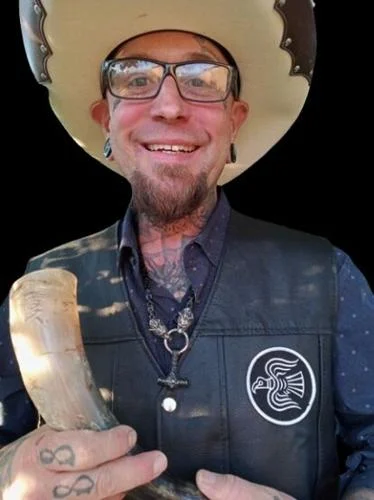
Zachary Babitz as a Heathen
and member of the AFA
Last week, I was contacted by a reporter from Santa Fe, New Mexico who wanted to talk about the Asatru Folk Assembly (AFA) and the case of Zachary Babitz.

Here's the story: Zachary Babitz was arrested in Las Cruces on August 11th after robbing an Arby's restaurant. He had recently been released from prison on parole in March (which of course has local politicians calling for tougher sentencing.) He has also been charged for an earlier bank robbery in Albuquerque on July 31, 2024 as well as a carjacking in which he shot and killed an elderly man. Just horrible stuff. This statement from the U.S. Attorney General District of New Mexico contains a link to the official criminal complaint. So evidently, Babitz was released and tried to stay straight. He lasted for about four months and then fell back into criminal activity. Babitz's prison tattoos indicate his white supremacist connections. He has "1488" tattooed on his fingers: "14" stands for the 14 Words of infamous racist murderer David Lane, and "88" represents the double letter "H" the eighth letter of the alphabet, signifying "Heil Hitler."  

The reporter contacted me because Zachary Babitz was a member of the AFA. Not only that, but in mid-July just a couple of weeks before all this went down, Babitz had been named an apprentice Folkbuilder for the AFA in New Mexico. (All references to this had been deleted from the AFA's social media, soon after Babitz went on the lam. A Google search found links to those posts, but they had been deleted on the actual webpages.)

 
Screenshot of my Google search results
for the Folkbuilder announcement
So what happened and how was the AFA involved? Please note that I did reach out to a local Folkbuilder for a comment about this case, but have received no response. What I am writing here is my own current interpretation based on what I know, although could and probably will change. I think the case shows us a few things about the AFA as an organization.

The Asatru Folk Assembly has always been a folkish Asatru group, meaning that they interpret Heathenry as a religion for those of Northern European heritage. It was founded specifically as a folkish group by Stephen McNallen in the mid-1980s, primarily to combat the rise of "universalist" Asatru as represented by the Ring of Troth organization, now The Troth. (See my book Being Viking for more discussion of this history.)  For the AFA, this has come to mean "white Americans" in particular. So they have always been attractive to working-class people with a racial or a racist worldview. Since 2016, the AFA under Matt Flavel has been very open about this and has sought to raise its profile on the far-right, by appearing on far-right internet shows and courting white nationalist groups.

However, the AFA has always presented itself as a family-oriented religious group, a church so to speak. That is, it has never been a skin-head group like the Hamerskins, nor a militia like the 3 Percenters, nor a far-right white nationalist group like the KKK or Proud Boys, nor a neo-nazi group like the National Socialist Movement. 

Babitz (on the right in cowboy hat)
at the AFA New Mexico moot
Babitz is actually pictured as a family man on the AFA social media in a photo of the New Mexico moot on July 1,2024. The photo shows two seemingly happy families enjoying a social event. The photo tones down, or even washes out the white supremacist and violent felon image of Babitz. This is in keeping with the AFA ethos. The photo in no way signals what Babitz was about to do one month later. (The day that Babitz cut off his ankle bracelet and began his crime spree, he actually left a note on the door of his home stating that his wife knew nothing about what he was about to do.) 

Babitz likely made contact with the AFA while in prison and formalized that connection after his release on parole. I believe that he became a part of the AFA in his attempt to re-enter society, jump start his family life, and stay straight. But in the end he couldn't hack it - he ditched his family, went on a drug-fueled crime spree, murdered an innocent man, and significantly embarassed the AFA.

When Stephen McNallen talked about "coming home" to Asatru - he had in mind middle-class white American families. McNallen started his Asatru Community Church in a branch of the local library, after all! That says a lot about his intended audience. He believed in mainlining Asatru for the average white American nuclear family. 

Matt Flavel, the current Alsherjargothi of the AFA, has a slightly different idea. For him, "coming home" refers to the "lost" boys - down-and-out young white Americans with racist tendencies who are struggling with life, who can't hold a job, who struggle socially, perhaps have been in prison or in racist groups. Coming home means finding the AFA, entering a community that will accept and affirm them, that will give them a structure, a sense of meaning and community, order and purpose, help them get on their feet, find a job, start a family, and become a productive and contributing member of society. And the AFA hofs serve as these regional face-to-face communities where people can come and connect with a strong community of "like-minded" others. Probably, Flavel sees himself and his own life trajectory in that story. This means that the AFA is reaching out and taking risks with people on the margins, with racist, violent, and criminal histories. They see those lost, overlooked whites as their own people. They believe that Asatru can help. They see the struggles and criminality in part as a result of anti-white sentiment in America - that America has turned against white people, especially working class whites. That is part of the social narrative the AFA is telling. Largely, this strategy has been successful for the AFA - many of their members were struggling, lost in life, then found the AFA and are doing better. 

So the AFA became that for Babitz - a struggling guy who wanted to go straight. He evidently had someone in the AFA vouching for him, to account for his rapid appointment into an entry-level leadership position. The apprentice Folkbuilder in the AFA is sort of a test-run, trial position. So I think that the AFA was trying to help Babitz aspire to a better life. But obviously, they misjudged him and couldn't really help him. This can happen to an organization that is expanding too rapidly and promoting marginal people into leadership positions without significant vetting and time. 


Verity Vox and the Curse of Foxfire

Don Martin, Verity Vox and the Curse of Foxfire , Page Street YA, 2025. I purchased this book from Amazon with my own money. Verity Vox and ...