Saturday, July 20, 2024

Review of Eruption by Michael Crichton and James Patterson

My phone camera is done
This month our book club read Eruption, by Michael Crichton and James Patterson.

To a great extent the book reads like a screenplay. Short chapters sketch out the action, each ending with a small cliffhanger of some sort. It is a thriller and much of the action is compelling, with some intense and engaging descriptions of volcanic eruptions, fiery death, and havoc. The pace of the novel is inescapable, with an "hours until eruption" countdown at the top of most chapters. Of course, it is not just the eruption that drives the plot. There is a military cover-up that amps up the stakes to an apocalyptic level, the fate of all life on the planet hangs in the balance. 

Only a few heroic characters stand in between us and the impending destruction. These heroes are made for the movies, as Rob Merrill writes in his AP review, "The book’s characters are straight out of central casting."  Ron Charles' review in The Washington Post points out that the "casting suggestions are embedded right in the text," which at various moments compares characters to a certain generation of movie stars like George Clooney, Pierce Brosnan, and Halle Berry. The protagonist is the passionate, no-nonsense, chief scientist of the Hawaii Volcano Observatory, John MacGregor, aka Mac, who has a soft heart for those he loves. He teams up with the rugged, take-charge General Rivers, chairman of the Joint Chiefs of Staff, who has flown to Hawai'i to coordinate the disaster response. The beautiful but overlooked planetary scientist Jenny Kimura hangs around in the background waiting for moments to console love-interest Mac. And so on, with a host of other made-for-cinema characters including a young, gorgeous demolitions expert; a young, gorgeous NYT reporter; and a few young, handsome Hawaiian surfers ready for a few scenes catching the waves on Hilo beach.

The book becomes more interesting if we turn to some questions that can be raised adjacent to the storyline. Here are a couple I've been thinking about that tie into religion:

This is a doomsday story about the impending destruction of the world - literally a fire and brimstone scenario of biblical proportions that is about to be unleashed on humanity. It is an apocalyptic story. While the eruption of the volcano is a natural phenomenon, it enacts a sort of justice on human foolishness and hubris. The volcano chasers - arrogant, rich, attention-seeking dilettantes - are the first to go in a morality play sort of way. But the potential for worldwide destruction is the result of a military experiment-gone-wrong. Hidden away on the slope of Mauna Kea are hundreds of canisters of a secret military herbicide code-named Agent Black, an unstable chemical agent that makes Agent Orange look like Kool-Aid. Contact with the lava would release a chemical plume so toxic that it would contaminate the entire globe and wipe out all life on earth. The impending apocalypse draws this human flaw into focus, this sin of military-industrial hubris, the urge to control and to wield death as we would choose, now threatens all life. 

This really is the religio-ethical function of apocalyptic literature - to draw attention to the sins, flaws, immorality that we tend to overlook or accept as normal, especially the structural and systemic conditions that subjugate, dehumanize, and inflict suffering on common people. Apocalypse pulls back the veil of normality and reveals the hidden ethical tensions, the fatal flaws -  that are embedded in human societies. Apocalypse reveals how power is distributed and flows in ways that perpetuate injustice, violence, and evil. By revealing and condemning these inequities, forecasting their imminent destruction, apocalyptic literature calls us to pay attention to our social injustices in one way or another. Too bad this book will be taken for simply a thriller and its implicit critique of the military-industrial complex and the long-term global environmental damage we have done will be ignored or lost to most of its audience. Likely, it will not compel its white conservative American readers to take stock, reject militarism, acknowledge the real environmental crisis we have created, and to come together around real solutions and social change.

The second religious theme is that of animism. The book explores or at least references a good deal of volcano and earth science, very interesting stuff. The use of popular fiction to explore science along with its triumphant and horrific implications is Crichton's specialty. However, the book also puts forward the possibility that despite everything the scientists know, there is another way to look at the volcano, another frame of reference that is preserved in the animism of the Native Hawai'ians. The best description of animism comes in a conversation among the Native youth surfers as they argue about who really knows about the volcano. Lono, a Native teenager who is mentored by Mac the chief scientist of the Hawaiian Volcano Observatory, takes the side of science but not without some cognitive dissonance. 

    "I know what I heard and what I saw," Lono said. "These guys are scientists. They know what they're talking about" 
    "Haole scientists," Dennis said. (1)
    "I'm telling you, they were talking about something loa big," Lono said. "And loa bad." (2)
    Lono, kama'aina like his friends, knew all the myths and legends about volcanoes, the way old people like Dennis Lee's grandmother thought of them as powerful living creatures who were not to be interfered with for fear of their response. (3)
    (Crichton/Patterson, Eruption, 168-69, italics are in the original text)

I bought this poster of Pele, by Herb Kawainui Kāne, 
when I was at Hawai'i Volcanoes National Park in 1995.
This short passage is not a bad description of animism. The Native elders (aka Dennis Lee's grandmother) are the keepers of traditional knowledge. They comprehend and relate to the volcano not as a thing and not through the physical data of science but as a person, a being. To them, the volcano is "a powerful living creature" as Crichton/Patterson puts it (although I would use the term "being" instead of "creature" - the volcano is a goddess, a creator more than a creature.) This description is consistent with animism and works better than the older terminology of "spirit" or "spirit being" which tends to overly spiritualize the sacred being as somehow otherworldly or ethereal.) We are not talking about a spirit that lives in the volcano, but the volcano itself in the world as a being of immense power, presence, and agency capable of giving and creating land and life and also capable of acts of great, cataclysmic destruction and violence. The human beings dwell on the island with this powerful living being, in the presence of and in relationship to her. In the course of this relating, this powerful being is sometimes thought of and addressed as the goddess Pele. She is the volcano, or the volcano is the embodied aspect of Pele

Despite this quick glance, the book missed the opportunity to present a more robust and compelling picture of animism. None of the main characters expresses or supports an animistic view. The passage relegates the animist perspective (rather than entrusts it) to a very minor character's grandmother who never actually appears in the book. In a later passage,  animism appears again, in the one brief appearance of Lono's fundamentalist, anti-science, fatalistic Native mother. Despite the impending danger, she "stubbornly refused" to listen to reason and evacuate. (Eruption, 400) Note that the  authors use the word "refused" three times in a row here to characterize Lono's animistic mother as both ignorant and contrary). Instead of evacuating in the face of imminent danger, she tells her son:

    "The goddess has always provided for us . . . . It is Pele's will at work now. Not mine or yours. Not your friend Dr. MacGregor's."
    "Are you saying it's her will for us to stay and die in this house?" Lono asked.
    "You must have faith," she said. "You were raised in the ways of the natural world, and you were also raised in the ways of the spiritual world."
    But I'm growing up in the world of science, he wanted to tell her. In the real world.
(Eruption, 401, italics are in the original text.)
      
This passage seems wildly out of touch with the actual lived animism of Native Hawai'ian people. This artificial conflict between "faith" and "science" is more characteristic of the conservative Christian stance against evolution, and even there it is more nuanced. Unfortunately, Native Hawai'ians have been characterized frequently and unfairly in this way. During the protests against the Thirty Meter Telescope on the slope of Mauna Kea where so much of this book takes place, scientists called the protestors “a horde of native Hawaiians” and wrote stupid things like "It seems to me that it's an argument about returning to the stone age versus understanding our universe and it'll be interesting to see who wins in the end." Yet as Native spokespeople made clear: "The conflict was never between our culture and western science,” said Wong-Wilson, who is executive director of the Lālākea Foundation, a group of cultural and spiritual practitioners. “We’re as fascinated with our view of the heavens, our view of constellations, and our relationship [with them] from the Native perspective as anything.” Rather, she said, the issue was “the use of particular areas of land, of which there may be conflicting interests.” 

Ultimately, there are no strong or compelling Native Hawai'ian voices in the story, even though the book is set in the geographical heart of Native activism in Hawai'i. The traditional Native religious perspective is circumscribed and misrepresented despite the fact that Maua Kea has been the site of Native activism and organizing for years and despite the many articulate explanations of Native Hawai'ian spirituality. Yes, the Thirty Meter Telescope protests occurred from 2014-22 and Crichton died in 2008, so his original story predates that event. But Patterson's rewrite could do a lot more to frame the story in light of Native Hawaiian worldview, religion, and resistance. Yes, the novel includes a protest in Hilo - but it is quickly coopted by the two main haole characters - the scientist Mac and the army general Rivers, whose voices and perspectives dominant this book, subverting the alternative visions, identities, and solutions of Native people and religions. 

Notes:
1. The Hawai'ian language term haole emphasizes that these are white scientists, outsiders, who shouldn't be completely trusted.

2. Loa is an important Hawai'ian concept of distance and measurement. After reading this article, I think it is communicating the sense of something cosmic, an event with a magnitude that transcends human comprehension and scale, beyond the human ability to control and handle. It signifies the sacred nature of the volcano and the magnitude of its agency.

3. Kama'aina literally "child of the land" refers to those native to the Hawai'ian islands. According to Kiope Raymond at the University of Hawai'i, the word carries connotations of the Native Hawai'ian animistic relationship to the kalo plant, from which the Hawai'ian staple food, poi, is made.

Monday, April 1, 2024

Ecosystems: Dune vs Fantastic Beasts

My family are fans of the Wizarding World of Harry Potter. My children grew up reading the books and watching the movies repeatedly. I have also watched the movies and read a few of the books. We have always enjoyed the world that J.K. Rowling created and continues to develop. 

I was excited about the Fantastic Beasts movies and enjoyed them. The animal theme was particularly appealing. There were so many animals and plants in the original novels of which we only get quick glimpses or brief interactions. This is an entire dimension of the Wizarding World that could be explored. 

But something always seemed missing. I was disappointed that the beasts - the animals who inhabit this world - were not really the point. While the various creatures take on a larger role, more screen time, than in the original movies, they are still a sideshow to the primary plot and the human characters. The creatures provide entertaining and comical episodes. They provide moments of the  sublime, wonder, and amazement. They provide help to the characters at important moments of the story. But they are always ancillary to the human characters.

In addition, the human-animal relationships never sat well with me. The creatures are primarily kept in the protagonist Newt Scamander's suitcase, which is something like a magical zoo. The scenes inside the suitcase are remarkable - it is a whole dimensional space with multiple rooms or ecostyems for the various animals. Ostensibly, their confinement in the case is for their safety. And one of the subplots of Fantastic Beasts (okay, it is not really a plot, it simply provides the reason or motive for Scamander to be in the United States) that is Scamander has rescued Frank the Thunderbird from animal traffickers and is transporting the Thunderbird back to the American Southwest in order to release him into his native habitat. All that is fine. But the reality is that most of the animals are kept in the suitcase. One of the repetitive themes in the movie involves the various creatures escaping from the suitcase. Scamander is always tracking them down to recapture them and put them back in the case.   

Maud Dib, the desert mouse from Dune
While listening to the Imaginary Worlds podcast, I realized something else that was missing from Fantastic Beasts. The world is truncated, without well developed ecosystems in which these animals live. The podcast episode was actually about Dune and the fictional ecology of the desert planet that Frank Herbert created. The podcast episode quotes Veronika Kratz, now a postdoctoral fellow in the Department of English at Queen's University in Ontario, Canada. She admires how Frank Herbert was able to create and portray a complex ecosystem in Dune.     "I think that just that representation of a complex ecosystem is something that in my mind very few authors have done, period. Even still today. That development of a really complex world that feels lived in, that feels . . . and not just lived in by people, but by lots of different creatures and lots of different forms of life and that its changing and evolving. That's something that's really hard to capture. And most writers, when creating fictional ecosystems especially, often don't bother. You''ll find really simplified ecosystems."  Imaginary Worlds, "The Ecology of Dune," 19:02-45

Kratz pinpoints the larger problem with Fantastic Beasts. There is no attention to the worlds of these animals and the ecosystems of which they are apart. No animal can live without its ecosystem. We tend to abstract animals from their ecosystems - but in reality no animal can thrive or perhaps survive for long apart from its place in the ecosystem. The animal and the ecosystem are intertwined. But in Fantastic Beasts, the ecosystems are not developed. For all the love that Nest Scamander has for these animals, he is still a collector. The animals are abstracted from the enivroment, confined in the suitcase, and live truncated lives in a human-oriented world. The animals and their worlds are missing and that made the movies feel disappointing.

Perhaps that is a lesson for us - a glimpse into the shrinking worlds of wild animals. As we continue to massively alter global ecosystems, the animals who will survive are those who can adapt to living within the human-oriented world and ecosystems that are radically changed by human interventions and interference. 

Monday, March 25, 2024

Can Horror Serve as Lament?

Why aren't the dead mourned in horror?  In horror, the focus is on surviving, on not being dead - so the camera and the audience's attention quickly moves off the dead and onto the living, the survivors. In some way, death makes the dead impure and survivors must flee, distance themselves from the dead unless they too end up dead.

Horror often moves fast - to stay alive, you have to be one step ahead of the killer - so one cannot linger with the dead. Consider this scene from The Walking Dead, Season 1, Episode 5 in which Andrea's younger sister - an innocent - falls prey when the camp is over run by a zombie horde. Andrea kneels over her sister, mourning her death. "Amy, I am sorry," she says "for not ever being there. I always thought there would be more time." But there simply isn't time. The mourning turns into horror as Amy gradually revives. First a soft breathing, then the reanimated corpse slowly almost tenderly raises her arms as if to embrace Andrea, then snarling and attacking as a fleshing-eating zombie. Andrea pulls out a pistol, whispers "I love you" as she shoots her zombie sister in the head. 

(Caveat: In the full scene, Andrea is actually granted much more time to mourn - an uncomfortable and excessive amount of time for some of the group. She sits with her sister's corpse for hours, maybe a whole day or more, holding a sort of vigil. In fact, the group is busy burying other dead people, not wanting these deaths to be unrecognized and devoid of sentiment. The group grants her and themselves some time and space to mourn. But only contingently - they hover around her in their nervous distress, interrupting politely but insistently to hurry her up, to end the delay, so the group can move on. Everyone knows that the sister's corpse will turn into a zombie sooner or later.)  

Here we see both the theme of impurity -- the sister's corpse is infected, impure, it must be destroyed. To live means to separate from it, to avoid being infected by it. The dead are contamination, waste material. There is also the theme of haste - there is no time to mourn because this must be dealt with immediately, lingering makes us all more vulnerable. Perhaps mourning is ultimately stupid or misguided from an existential perspective because the person is no longer there and what returns is a threat. 

At time in horror, the dead are protrayed as responsible for or at fault for their demise. If they had been smarter, faster, stronger, more observant, more ethical then perhaps they would have avoided death. The silly frivolous sexually promiscuous teenagers of the Halloween and Friday the 13th films may be examples of this. The victims in these slasher films tend to be those engaged in "illicit sex, illegal drugs, and general adolescent irresponsibility" while the "final girl" fights back, fortified "because she represses these very impulses and desires, in particular, retaining her virginity. . . .Abstinence and rectitude evidently give final girls the power to fight back and survive" (Rick Worland, The Horror Film: An Introduction, 228-29). Their death is a judgment, the killer's vengeance is something like a secular wrath of God that is visited upon the sexually immoral. Jess Peacock writes "In the world of Friday the 13th where teens take drugs, engage in wanton sex, and…gasp…go skinny dipping, Jason Voorhees appears as a nightmarish fundamentalist Christian champion, God’s unstoppable angel of Death. He imposes judgment on those who fail to sprinkle their door with the blood of moral uprightness. He is the arrow straining against Jonathan Edwards’ righteous bow [referencing his sermon "Sinners in the Hands of an Angry God"]. In these examples, the dead aren't mourned, cannot be mourned, because they just got what they deserved.

This theme came up in a question I was asked at the AAR in San Antonio. In Old Gods of Appalachia Season 1, Episode 2,  a group of African-American workers are brought into Barlo, Kentucky to break the strike at the Old Number Seven mine. These workers are all killed in the mine explosion. In my reading, the podcast portrays these strike-breakers in a sympathetic light. They are victims of the merciless capitalist system, exploited workers reduced to a state of inhumane vulnerability without protection, dignity, or even names. The podcast portrays their deaths and their subsequent internment in anonymous mass graves as a moral offense. 

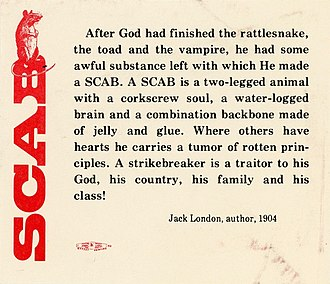
At the AAR Religion and Science Fiction session, the questioner asked me if this portrayal was nuanced by the moral complexity or culpability of the scab. The questioner referenced Jack London's short essay "The Scab," in his book War of the Classes, which presents the scab as a traitor, worse than Judas. "When a striker kills with a brick the man who has taken his place, he has no sense of wrong-doing.  In the deepest holds of his being, though he does not reason the impulse, he has an ethical sanction. . . . In addition to the use of bricks, clubs, and bullets, the selfish laborer finds it necessary to express his feelings in speech. . . . the selfish laborer applies the opprobrious epithet a 'scab' to the laborer who takes from him food and shelter by being more generous in the disposal of his labor power." Following Jack London, the questioner was asking if the scab is morally at fault? Not just a victim of capitalism, but someone who has chosen a morally wrong path--the scab is essentially stealing someone's job, stealing the food from off their family dinner table. Thus, the violence perpetrated on the scab is simply justified as retribution or justice. Much like Michael Meyers, the scabs receive their due by dying in the mine explosion.

But all this made me ask "Can horror help us to see the dead in new ways? Can horror serve as lament?" 

In Old Gods, the scabs return as zombies "burned Things" and destroy Barlo, tearing the entire town down. At first, I thought this was a type of justice, vengeance for the town's treatment of them. But I don't think so - even in their death, these zombie scabs can't escape their exploitation. Revived as zombies, they continue to serve the interests of the Dark, tortured and exploited even in death, given no rest, perpetrating even more horror on the town and people of Barlo.  

Why aren't they mourned? Why doesn't Old Gods take a moment to stand at the mass grave of these exploited workers and lament? It was a missed opportunity in Old Gods - these scabs come back as zombies to wreck the town, to take vengeance, and to enact a sort of moral accounting for their deaths. But there is no sense of memorializing them. Perhaps Old Gods could have taken time to treat these workers with more complexity and compassion, to tell those stories or to erect a virtual monument to the memory of those who died in the mines. However, there isn't really any lingering with these dead. There is a buildup of moral outrage, but not a transformation in the audience's perspective.

Image #1: AI image generated by Bing Copilot Designer with the prompt "mourner standing by a lonely overgrown grave in the woods dark colors drawing sketch pastels"

Image #2: AI image generated by Bing Copilot Designer with the prompt "worn overgrown gravestone cemetery gloomy trees mourner standing laying flowers crying sketch drawing black and white"

Friday, March 22, 2024

The Blue Line Project, Circular Church in Charleston, SC

 Almost every year at our academic conference, someone brings up the relevancy of these meetings. Are we just talking without any effect? In our Religion and Nature section, we are trying to make connections to local activists and eco-justice projects. It is something that we have been thinking about for a couple years and I was able to pull it off this year.

Circular Church,
Charleston, SC
photo by author
I just started searching the internet for churches and community groups in Charleston, SC that were doing work in environmental justice. I found Circular Church, a UCC congregation pastored by Jeremy Rutledge who did his doctoral work in religious naturalism. The church has its own Climate Work Group and also participates in the Charleston Area Justice Ministry. Pastor Rutledge as keen to be involved, so things started tracking from there.

On its historic campus downtown, Circular Church has set up a Blue Line Project that shows anticipated sea level rise and storm surge. As the church website states, "Blue Line Projects are found around the world in coastal communities seeking to draw attention to the climate crisis. Many blue lines mark the height to which sea levels are expected to rise."

Circular's blue line marks the height of the storm surge if the 1989 Hurricane Hugo were to land in Charleston again. Hurricane Hugo was a big and devastating storm. Of course, the reality is that with climate change and rising ocean temperatures, storms are becoming bigger, more powerful and dangerous. The next hurricane to land in Charleston may indeed be worse than Hugo. 

Circular's Blue Line Project is pretty modest, to be sure. It consists of four small informational placards, and future storm surge levels marked on the wall of one of the church buildings. 

What do you think about this as 1) a type of environmental justice action, and 2) as a religious practice?

The religious and the environmental are not separate of course - the blue line project is both. As the signs indicate, this awareness of climate change and its impact arises from the religious and ethical imperative to love the world and care for the neighbor.

Blue Line Project at Circular Church,
photos by author
As a religious practice, the signs serve as reminders of what or where one's core ethical commitments should be. 

As people - congregation members or visitors - walk through the historic cemetery surrounding the church, they have the opportunity to be aware of the place where they are - note how the placards point out that Charleston is particularly at risk, how "you are standing at 10.4 feet above sea level" on the church campus, how the public housing projects - such as the one by Gadsden Creek - are in lower-lying areas. 

So it is a very place-based sort of approach. The blue line project is a sort of augmented reality. It overlays a future potentiality onto the present. By marking potential storm surge, the blue line asks us to see the place from a different perspective. It's not "what if" but "when this place is underwater." Can you see the place with this in mind. If you have that awareness of "when," the inevitability of that, then how does that change the way you live in the place now?

In The Location of Religion, Kim Knott writes about the simultaneity of space - that spaces are "synchronically dynamic because at any time they are overlapping, co-existent, in parallel with other spaces, and because they are internally in tension, being made up of multiple, contested, real, and imagined sites and relations." Synchronous spaces, she writes, "contain the past within them" like a palimpset (Knott, 23).

But they may also contain the future within them. Or potential futures that can be marked or indicated in certain ways. And that is how I understand the blue line project. It indicates this simultaneity of space - that both the past - like Hurricane Hugo - and potential futures - like devastating storm surge - are present, contained within the space in the present, all simultaneously experienced if we can become aware of it. As Knott points out, these are not "layers" like a slice through time, but the "dynamic and simultaneous coexistence of social relations" in that space (Knott, 20).

Friday, January 26, 2024

Eastbound by Maylis de Kerangal

The Trans-Siberian Railway running
along the shore of Lake Baikal
A sense of disorientation pervades this short novel. 

Eastbound was written by French author Maylis de Kerangal, published in French in 2012 and in English by Archipelago Books in 2023, translated by Jessica Moore. 

The basic story is this: Aliocha is a young man who has been conscripted into the Russian army. Despite efforts to avoid military service, he finds himself on the Trans-Siberian railway rattling across the endless taiga to some unknown Siberian destination for his military training. Desperate to escape, he strikes up a relationship with a foreigner, a French woman who is also riding the train. They become co-conspirators, hiding Aliocha from the vicious sergeant Letchov for the duration of the trip so that Aliocha might escape and be free.  

The novel begins with disorientation. The opening sentence of the story is "These guys come from Moscow and don't know where they're going." So already we are on a journey into nowhere. To pass the endless time, the conscripts bully one another aimlessly. The disconnection is profound. Early in the book, two nameless conscripts come up behind Aliocha on the train and begin to harass him, pushing and punching. At first he plays the victim. But eventually Aliocha turns and with sudden violence punches one, sending him sprawling to the floor. The buddy, left standing there, "looks at his friend lying there among puddles of beer and cigarette butts, looks him up and down, expressionless, and then even gives him a kick in the side, turns on his heel and abandons him there" (15-16). No good samaritans here, only profound isolation and alienation. Everyone is a stranger.

Aliocha himself is disoriented. Wanting desperately to escape, he looks for a map listing the train stops, but he can't find one -- talk about a classic existential dilemma (18). He is simply lost on this train in a world of brutes and sadists. He loses track of the days and the time. He doesn't know how long he has been on the train. His memory is patchy and he can't string it together, "Aliocha concentrates hard to locate a few temporal reference points . . . .but fails to restore the sequence of nights and days since Moscow, fails to identify what the date is today" (91). He is disoriented about the people around him and the world in general. When he first encounters the French woman Hélène, he confuses her for an American perhaps "from Wyoming or Arizona" (38). So he knows nothing, and even confesses that he knows nothing about western women (69). And because of the language barrier, they can only communicate in pantomime.

Hélène the other protagonist is also disoriented. She too is trying to escape, from Siberia where she moved with her boyfriend yet now feels alienated, "how difficult it was for her living here, out of place, out of her own climate, her language, blind and deaf she would say over and over, laughing, and alone (55). Impulsively she takes the train, trying to leave Russia behind but going in the wrong direction, eastbound toward the sea. Her own sense of the world is disoriented, "she has a tragic and patchy image of Russia, a jumbled montage (59) of books and snippets of images from media and the news. There is no integration no wholeness, just a jumble of phenomenological perceptions. She also is devoid of purpose. She doesn't know where she is going or why. She chooses to help Aliocha seemingly on a whim. She doesn't know him and doesn't know why she even decided to intervene. "What's done is done," she tells herself (50). It's just a choice, made "without hesitation, without even weighing his requiest"  that sets things in motion, creates a bond between these two strangers. Aliocha muses that "she may not even know why she did it, maybe just for fun, to play the game" (69).

Meanwhile, the train rolls through the endless Russian landscape. The landscape through which they move is also bewildering, without human scale. It takes on many meanings throughout the journey. It is an abyss in which one disappears, a "blurry territory from which no one returns" (10).  It can be an inhuman and alien landscape, the endless taiga, "the skin of the Earth, the epidermis of Russia" (41), it is the "realm of bears" (48). It is rapturous sublime of Lake Baikal, so mythic that the one compliment Aliocha has ever given to a woman is that her eyes are like Lake Baikal (71) - a lake that he nor she has ever seen. In one of the best descriptions in the book, the train compartments erupt in hot-cultured expressions of ecstatic joy as Lake Baikal comes into view (85-88). 

On the train, Aliocha and Hélène exist in a sort of timelessness or jumbled time - time stretches and snaps, slowing and elongating then suddenly speeding up "the train that rolls unerringly, crossing time zones one by one, breaking up time as it charges through space; the train that compacts or dilates the hours, concretes the minutes, stretches out the seconds, continues on pegged to the earth and yet out of sync with earth's clocks (92). The passengers have "little by little renounced the alignment of their biological clocks with the terrestrial cycle of night/day/night, tick=tock-tick-tock and something else in the had given way, freeing an unknown temporality, elastic and floating" (124-25). This confusion of time is deeply disorienting, loosening their grip on what is real, what is happening. "Their REM sleep time has been whittled down as well, so they have trouble committing to memory the things they are experiencing" (125).

Yet within this profound disorientation, a precise drama unfolds. These strangers, thrown in this train together as the bewildering world rushes past, enact their own play, take sides, make choices, and risk all.  

This is French existentialism at its finest. We are all riding this train speeding into unknown, rushing through a bewildering world. Thrown in medias res  among these strangers - whom we don't really know, with whom we can only pantomime and not really communicate, just thrown together in this crazy ride with us. And none of us really know why. There is only the drama on the train, only the now, only the choice to act in the moment. All we can do is reach out, take a risk to connect as best we can with another stranger. All we can do is to act, to create our own story, to find a meaning and purpose in what we make of the world around us. 


Friday, January 19, 2024

Odinism and the Monstrous

This is an AI generated image made by DeepAI.org
with the prompt "haunted forest."
We live in a haunted age, a world of monsters. For all the technology and rationalism, the monsters lurk all around us. Have there ever been so many monsters?

Monsters are stories we tell and pictures we paint, literary or cinematic constructions that embody the fears and perceived threats that we can't otherwise name. Monsters haunt the pages of books, movies, media, true crime podcasts, government propaganda and campaign speeches, courtrooms and unsolved murder cases, all woven from the haunted threads of our own cultural failures and horrors, the dark fairy tales and monster stories of our own society.

In his article "Monster Culture: 7 Theses," Jeffrey Jerome Cohen writes that the monster's body is a cultural body. "The monster is born only at this metaphoric crossroads, as an embodiment of a certain cultural moment— of a time, a feeling, and a place. The monster’s body quite literally incorporates fear, desire, anxiety, and fantasy (ataractic or incendiary), giving them life and an uncanny independence. The monstrous body is pure culture. A construct and a projection, the monster exists only to  be read: the monstrum is etymologically 'that which reveals,' 'that which warns,' a glyph that seeks a hierophant. Like a letter on the page, the monster signifies something other than itself: it is always a displacement." (Monster Theory Reader, 38)   

The monster stalks the edges of imagination – the monster is the misanthropic rage, the moral desolation, the savage inhuman strength, the will to destroy without reason or purpose, a barbarism that would shred the sinews of civilization if we let it in. So it must be displaced--we must have an Other to take it on.

Monster theory is a type of literary analysis that deconstructs or decodes monsters into their constituent parts - not flesh and blood of course -- but into the social, cultural, religious, and psychological forces from which they emerge.

The Delphi murders – savage, unexplained, unsolved – of course they slip into the realm of the mythic, the realm of the monstrous. The conjecture posed by the defense has more akin with True Detective than to anything based in the factual evidence of the case. The defense distracts us - points us away from the defendant and toward the monstrous Other. Odinism – this shadowy vague threat – becomes a convenient place to displace our fears. 

What do we know about Odinism? What does the average person know about Odinism? Nothing--it is a blank slate, a shadow upon which fear and terror and blame can be thrown. Cohen points out that "the monster is difference made flesh, come to dwell among us. In its function as dialectical Other or third-term supplement, the monster is an incorporation of the Outside, the Beyond— of all those loci that are rhetorically placed as distant and distinct but originate Within" (Monster Theory Reader, 41).  So Odinism--already so strange, so bizarre, so enigmatic--comes forward as a monster. Clothed in the unknown, a vague, ambiguous, shadowy threat that provides a hook upon which to hang the fears, the unresolved nightmare, the senseless and savage violence of this horrible event that only a faceless monster could have perpetrated. 

In an immediate sense, it siphons off suspicion from the defendant -- accurate enough to be possible but vague enough to be unprovable. The defense has tried to build a narrative from the vague evidence that could be interpreted as pointing toward Paganism. This evidence--a bloody mark on a tree imaginatively reconstructed as a Fehu rune, the girls' bodies posed in runic shapes or as the hanged man Tarot card, a jumble of sticks thrown across the bodies that are supposed to be a runic sigil? It is the same "witchy" aesthetic that anyone could have picked up from watching the first season of True Detective or the latest folk horror movie.  

Enough perhaps to raise doubt, to raise new questions that will at least spin off into more months of delay, perhaps even rise to the level of reasonable doubt. Monsters can do this--in a scape-goating kind of way, they distract us, pulling our attention away from the immediate and casting it onto the vague, the distant, an imagined rather than a real evil. We can blame the monster rather than ourselves or one of our own.

To some extent we don't even need Odinism to be real - we don't need or want too many facts and details, we don't desire to focus in too much. To some extent we just need Odinism to be the monster, the placeholder for all the violence, savagery, misanthropy that we cannot make sense of or accept otherwise.

This monstering of Odinism is complicated for Norse Pagans, Heathens, and Pagans. Why? 

On one hand, Pagans participate in this monstering. It is a strategy to define contemporary Paganism as socially acceptable. It establishes a dichotomy between good Paganism and bad Odinism. It clearly distances Paganism from any association with racism, violence, sociopathic behavior. That's what the Odinists are. 

This is one of the unfortunate but ongoing stereotypes of all Pagans - that they are evil, demonic, engaged in human sacrifice, consorting with the devil, you name it.  Setting up Odinism or other categories as the Monstrous enables contemporary Pagans to say - we are not that. I remember being at a Contemporary Pagan Studies session a few years ago at the AAR conference and hearing the phrase "those racist Heathens" thrown about in a vague way - no one seemed to know who "they" were, - just a vague shadowy evil presence out there somewhere -  just that "we" weren't them.

But this monstering of Odinism may not work -- it might drag other Pagans along with it. Odinism as a religion of child sacrifice, runes, witchy symbols, violence, and evil may just cast its monstrous shadow over the rest of Paganism in the minds of the average American consuming this true crime material. Beware of creating monsters.

Cohen, Jeffrey Jerome. "Monster Theory: 7 Theses." In The Monster Theory Reader. Jeffrey Andrew Weinstock, ed. University of Minnesota Press, 2020.

Mittman  Asa Simon.  Dendle  Peter. The Ashgate Research Companion to Monsters and the Monstrous. United Kingdom: Ashgate  2012.

Monday, January 1, 2024

Runic Astrology

I actually checked the book out of
my local library and read it.
 Lister, Richard. The Book of Runic Astrology: Unlock the Ancient Power of Your Cosmic Birth Runes. London: Hay House, 2023.

There is a tension that exists between popularization and dilution -- not only in religion. Insiders often object to and resist the popularization of their tradition, whatever it may be. 

Should interested newbies be required to cross a high bar by working their way into a tradition through learning, training, and experience? Or should a tradition be made more accessible--simpler, diluted-- so that newbies can more easily enter it?

Back in October, a friend sent me this article from the Daily Telegraph, "How Viking Runes Can Transform Your Life" - a marketing piece for Richard Lister's book "The Book of Runic Astrology."  Lister is doing this for Norse Paganism--presenting it in a way that is easily accessible to those who are outside the tradition but intrigued and interested.

This isn't new. Astrology has been part of pop culture forever. But as Norse Paganism has become trendy through shows like Vikings, interest in runic astrology has also grown. A few books have been published (two of which I have written about here and also available here). Even Vogue Scandinavia published an article on "reading your viking birth runes" and you can't get more pop culture than Vogue, right? Great stuff. With his new book and marketing savvy, Lister is making a play to be the popular expert on runic astrology.

And that makes sense. Lister is not a scholar of Old Norse or religious studies. He isn't a Heathen religious leader or gothi (goði). He is a holistic life coach who developed this system to do astrology readings with a Norse flair. His Norse Paganism isn't an artifice -- according to the book he has twenty years of experience doing viking historical re-enactment and a long personal history with Norse religious practice. In fact, Lister opens and closes his book by recounting two personal spiritual experiences he has had with Odin, the God of the runes. Given his Norse Pagan credibility, Lister is also an eclectic spiritual practitioner whose focus is working with people and their problems. And one form of guidance he offers is astrology with a Norse aesthetic. 

This is Norse Paganism crafted for the global consumer culture of late-modern individualism. Wyrd is not "fate" in Lister's interpretation. Rather it is a "guideline that we can influence," he writes, that is "always consensual." "You do you boo," he sums up (10). In Lister's approach, runic astrology is a tool that anyone can use to read the energy of the Wyrd, the "pattern and path laid out for us by the Norns," and navigate one's Runic Star Path to "co-create the life you want." 

In a sort of media-savvy makeover, Lister engages his niche market by overlaying traditional (Greco-Roman) astrology with aspects of Norse religion. The runic calendar of 24 runes of the Elder Futhark maps onto the astrological calendar of 12 zodiac signs. The names of Norse Gods are substituted for the usual names of planets and heavenly bodies. The elementals are loosely connected with figures from Norse myth. And the houses of the zodiac become Norse Stamme, "branches" of the world tree Yggdrasil. 

The power of Lister's approach is its simplicity. Even an astrological idiot like myself could easily get my free astrological birth chart from a website and use Lister's charts to find my birth runes. Lister calls this the "Runic Star Path" - quite catchy, right? : Gebo is both my Sunna soul rune  and my Manni emotional rune (Sun and Moon signs respectively.) Raidho is my Jord rune - the rising sign, or "rune of practical purpose" according to Lister. And Tiwaz is my Nordir or luck rune, equivalent to the North Node. Once you have these four runes, Lister provides his own set of descriptions to help you interpret your life journey. This transposition of astrology into a Norse timbre is topped off with a sprinkling of Old Norse neologisms--my favorite is glóa stigr the “Glowing Path Makers” (34), Lister's term for the three main birth runes. 

While reading this book, I definitely realized that my understanding of astrology is woefully lacking. I don’t really understand it and haven't spent much time on it. However it is an important dimension of Paganism and Pagan cosmology. Weren’t almost all the elder Pagan cultures in dialogue with the heavens? Tracking its changes, sensitive to its energies, aligned with its powers? There are hints in the Old Norse sources of astrological/astronomical sky lore in Pagan Scandinavia. Beyond Europe, astrology in Hindu religious culture goes back thousands of years. And there are fascinating discoveries regarding MesoAmerican astrology.  That said, not all Pagans use astrology. It is simply there as part of the cosmology, available as a spiritual resource. Even among the elder Pagans (arch-Pagans), some cultures and times would have made more of astrology than others. All religions change and consulting the stars undoubtedly would have waxed and waned as a popular practice.

Beyond the historical frame, astrology is congruent with the cosmologies of Pagan religions and the worlds of many powers they describe. Both polytheism and animism involve cosmologies in which many powers operate. Like these ontological systems, astrology is about living in an interconnected world – where all these powers interact and influence each other. These polyvalent interrelationships are sometimes referred to as correspondences in magical practice – things and qualities that are connected, influence each other, represent and resonate with other entities. Astrology is one type of interrelationship – a recognition that the movements and relationships of cosmic bodies influence our lives.

Lister's system is not particularly compatible with earlier presentations of runic astrology. For instance, there are few similarities with Nigel Pennick's book Runic Astrology. Even basic aspects like the God-planet associations are different: Lister associates Neptune with Ran while Pennick went with Aegir. Of course, Pennick's book is so complex to be almost impenetrable by the average person--as Lister mentions in this great interview "Change Your Life With Runic Astrology.". There is no attempt to connect this to archaeo-astronomy or actual Norse cultural knowledge of the heavens. As Lister makes clear, his astrology is about magic more than "maths" - "This is more than just rune maths and planet maths. It's trusting your intuition, your insight and your heart. Trust your feelings as you build Runic Star Paths for yourself, your event or your clients. This is where power is to be found. Right there. In you. Your heart will lead you to victory" (232)

For more on MesoAmerican astrology: An old but good article on the complex Mayan cultural relationship to Venus: Aveni, Anthony F. “Venus and the Maya: Interdisciplinary Studies of Maya Myth, Building Orientations, and Written Records Indicate That Astronomers of the Pre-Columbian World Developed a Sophisticated, If Distinctive, Cosmology.” American Scientist 67, no. 3 (1979): 274–85. http://www.jstor.org/stable/27849219. 

Additional Sources:

Claim Your Magic by Magin Rose

Donald Tyson, Runic Astrology

S. Kelley HarrellRunic Book of Days: A Guide to Living the Annual Cycle of Rune Magick

Nigel Pennick, Runes and Astrology

Harry Holland, Viking Astrology: Unveiling the Secrets of the Norse Runes

Kevin Rowan-Drewitt, Astrology of The Runes


Verity Vox and the Curse of Foxfire

Don Martin, Verity Vox and the Curse of Foxfire , Page Street YA, 2025. I purchased this book from Amazon with my own money. Verity Vox and ...